

It is easy to say you want your community to be more sustainable. It gets harder when the question becomes: more sustainable how? Should your city be electrifying buildings faster, planting more trees, building more housing near transit, cutting waste, expanding EV charging, or making climate programs more accessible to lower-income residents?
And once you identify a problem, there is another question: what can a city actually do about it?
A San Mateo County nonprofit has spent decades trying to make those questions easier to answer. Sustainable San Mateo County, founded in 1992, works with local governments, community organizations and residents around three interconnected elements of sustainability: environmental health, economic vitality and social equity.
Rather than focusing on a single environmental issue, much of its work is about giving people better information, practical examples and a clearer path into local action. Two of its resources are particularly useful if you care about what is happening in your own city.
Start by looking up your city
In August, Sustainable San Mateo County launched a major expansion of its free Sustainability Dashboard. The dashboard now includes more than 100 metrics across 13 topic areas, covering all 20 cities in San Mateo County along with unincorporated areas.
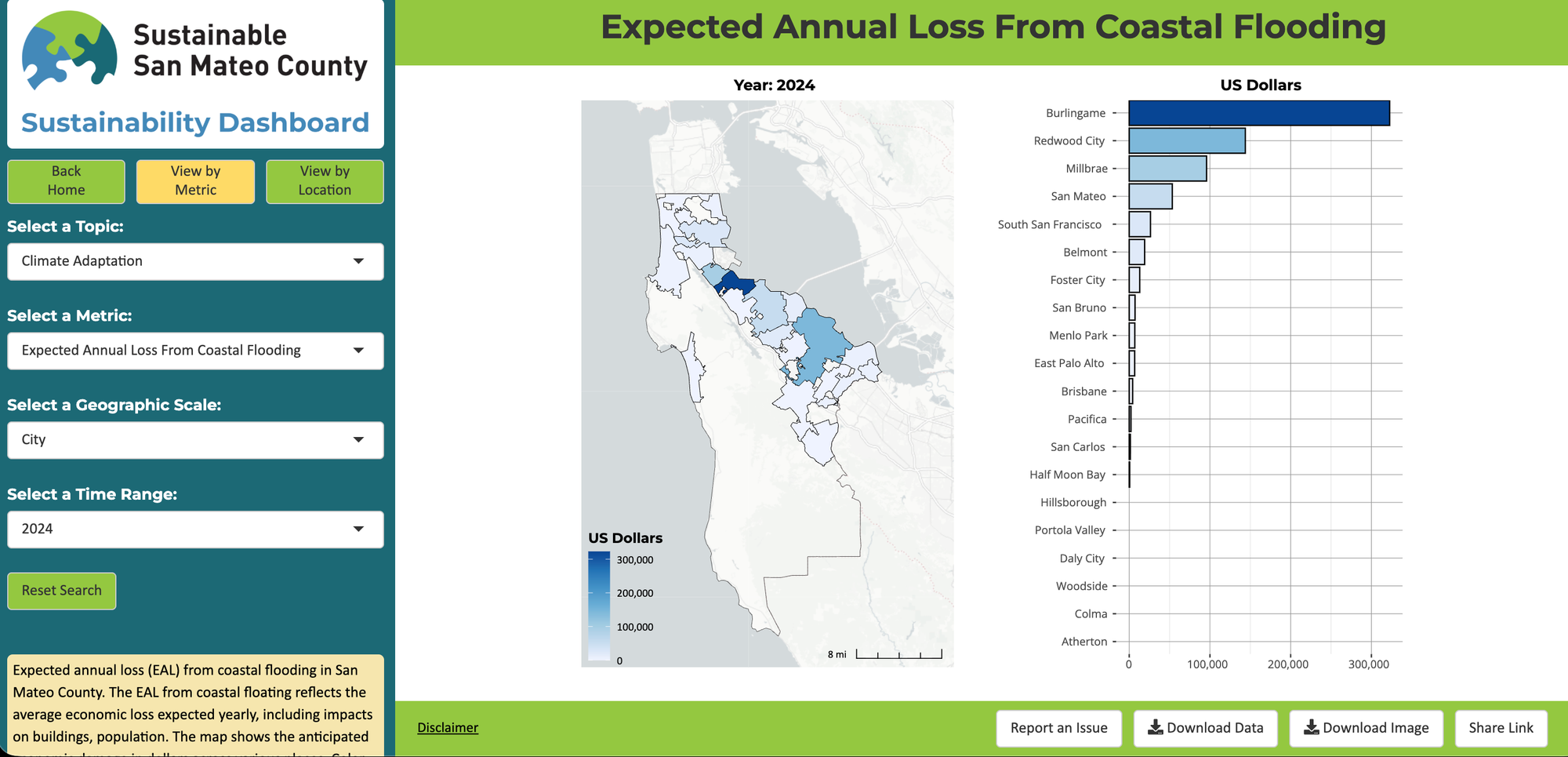
It includes up to 15 years of trend data and, for some measures, allows users to look below the city level at individual census tracts. That means you can move beyond broad questions about whether San Mateo County is becoming more sustainable and ask much more specific ones about the place where you actually live.
Is your city making progress on building and transportation electrification? How do its greenhouse gas emissions compare with neighboring communities? Where in the county are solar permits being issued, and how do housing, employment and income conditions vary from one community to another?
For some measures, you can go even deeper and look at differences between neighborhoods, including factors such as tree canopy and community vulnerability.
The dashboard pulls together data from sources including the U.S. Census Bureau, California Energy Commission, PG&E, California Department of Housing and Community Development, CalRecycle and local governments. Sustainable San Mateo County says it is intended for policymakers, nonprofits, advocates, grant writers and residents who want to compare communities and track changes over time.
You do not need to be writing a city climate action plan to find that useful. If you live in Belmont, Redwood City, Daly City, San Mateo or anywhere else in the county, the dashboard gives you a place to begin with a deceptively simple question: how is my community actually doing?
Explore the Sustainability Dashboard
Then see what somebody else has already tried
Finding a problem is only half the challenge. Suppose you discover that your community needs safer bike infrastructure, more access to green space, faster solar permitting or better options for renters. What happens next?
This is where another Sustainable San Mateo County resource becomes especially useful. Its Sustainability Ideas Bank collects policies and programs that have already been implemented elsewhere, giving local governments and advocates examples they can build from instead of starting every conversation from scratch.
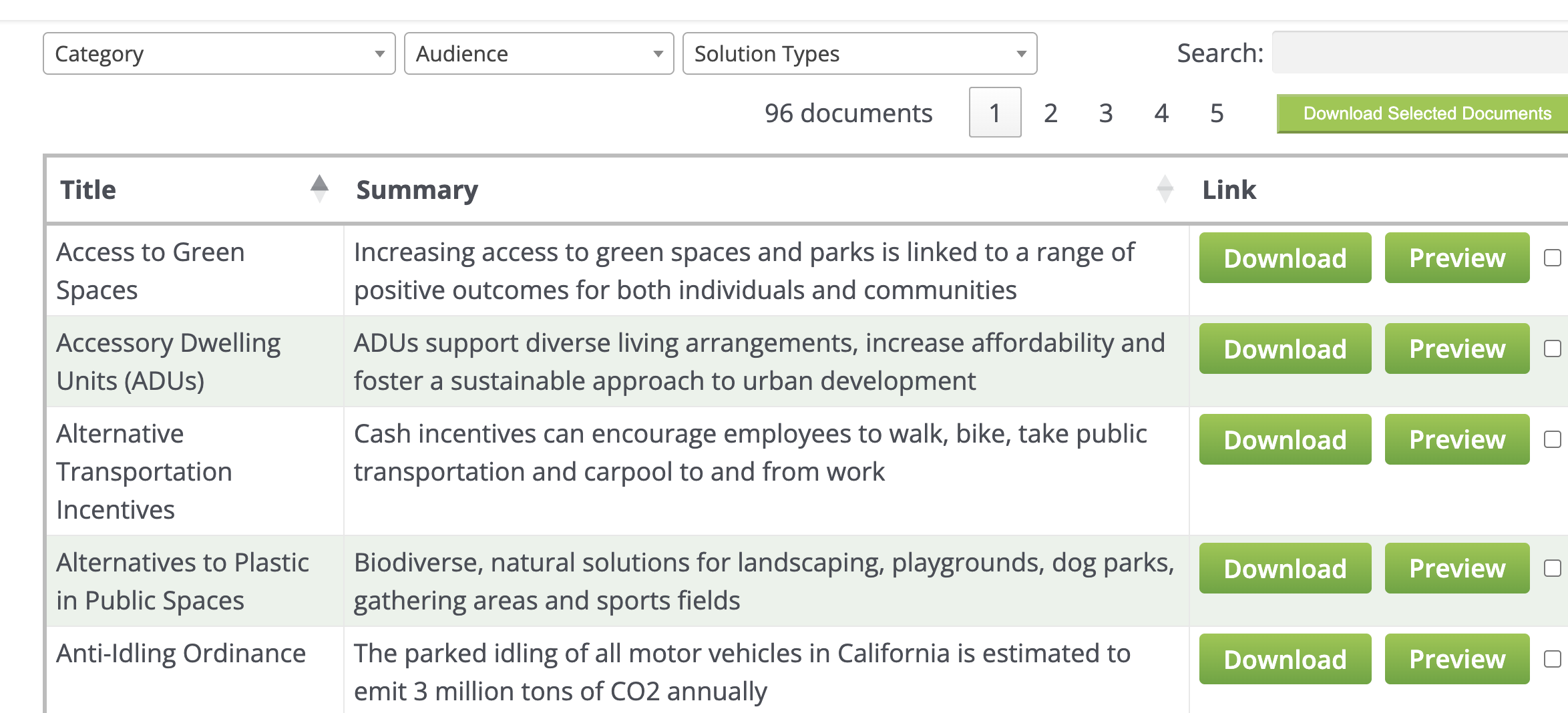
The collection covers environmental issues alongside housing, transportation, economic development and social equity. Search through it and you will find examples involving accessory dwelling units, quick-build street design, rain garden rebates, pollinator-friendly solar projects, recycled water ordinances, plug-in solar panels, green-space access and many other ideas.
What makes the Ideas Bank useful is that it does more than tell cities what they should consider doing. In many cases, it points to places that have already put an idea into practice, along with implementation details, policy language or contacts who have experience with the work.
For someone trying to advocate for a change locally, that can make a significant difference. Instead of going to a City Council meeting with only an idea, you can show that another community has already tried it and start asking what it would take to adapt that approach locally.
Explore the Sustainability Ideas Bank
The organization behind the tools
Sustainable San Mateo County has been tracking local sustainability conditions since 1997, when it began producing its Indicators Report. Over time, that work expanded into the dashboard, policy resources, community education, awards, youth programs and other efforts intended to help local leaders translate information into action.
Its definition of sustainability is intentionally broader than climate alone. The organization connects environmental health with economic vitality and social equity, and its dashboard reflects that by including measures related to housing, economic security, child care and community vulnerability alongside energy use, emissions, transportation, water and waste.
That broader approach makes particular sense in San Mateo County. Some of the country's wealthiest communities sit alongside substantial differences in housing affordability, income, transportation access and exposure to environmental risks. A sustainability dashboard that measured carbon emissions alone would miss a large part of the story.
The result is less a scorecard declaring whether a city is "sustainable" and more a set of tools for understanding where local communities are making progress, where they are falling behind and where residents might want to look more closely.
A path into local action
The most useful thing about these resources may be that they provide an entry point for people who care about an issue but do not know where to begin. You can start by selecting your city in the Sustainability Dashboard and finding one measure that surprises you, concerns you or simply makes you curious.
From there, search the Ideas Bank to see whether another community has tried something related. That can lead you toward your city's climate action plan, a local nonprofit already working on the issue, a commission or City Council meeting where the topic is being discussed, or simply a better understanding of who is doing the work locally.
Sustainable San Mateo County also offers volunteer opportunities involving research, communications, events and other projects. For someone looking for a deeper way into local sustainability work, that is another path beyond simply reading the data.
There is also a timely opportunity to meet people working across this ecosystem. On September 23, Sustainable San Mateo County will hold its Sustainability Gala at the Burlingame Community Center, bringing together people working on regional sustainability and resilience. Stanford Doerr School of Sustainability Dean Arun Majumdar is scheduled to give the keynote address.
Learn more about Sustainable San Mateo County
For FYP, the larger value of the organization is not simply that it advocates for sustainability. It gives people a way to move from a broad concern about their community to something much more concrete: understanding the local data, finding examples that already exist and identifying where they might plug in.
Finding your path does not necessarily begin with joining an organization or becoming an expert. It can begin much more simply, by looking up your own city, seeing what the numbers say and asking what someone nearby has already figured out.


